Our Answer
Neighborly allows neighbors to help neighbors with daily tasks. All participants are verified residents of that community, which fosters a sense of trust and enables stronger sense of group belonging. Users able to request help from their neighbors by posting in a social-media-like feed, and also offer their own help via an in-app chat feature.
How We Got There
Research & Analysis
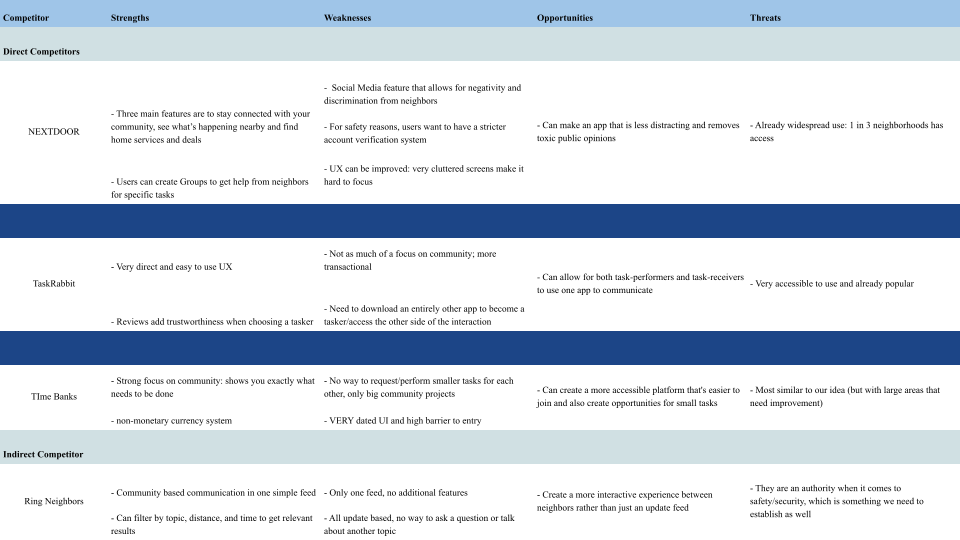
Our competitor analysis revealed that there are many task sharing apps available, although not all of them are community specific. These existing solutions do not fully address the need to manage smaller daily tasks however, since most of them are geared towards one-off projects or long-term community projects. The users we tested also did not adopt these apps due to concerns around trustworthiness and cost.
We conducted 6 user interviews and collected 8 survey responses from people that are decision-makers within their households. We found that all participants were willing to accept some level of help on their daily tasks from strangers, but there were some concerns about safety and trustworthiness.
Persona & Definition
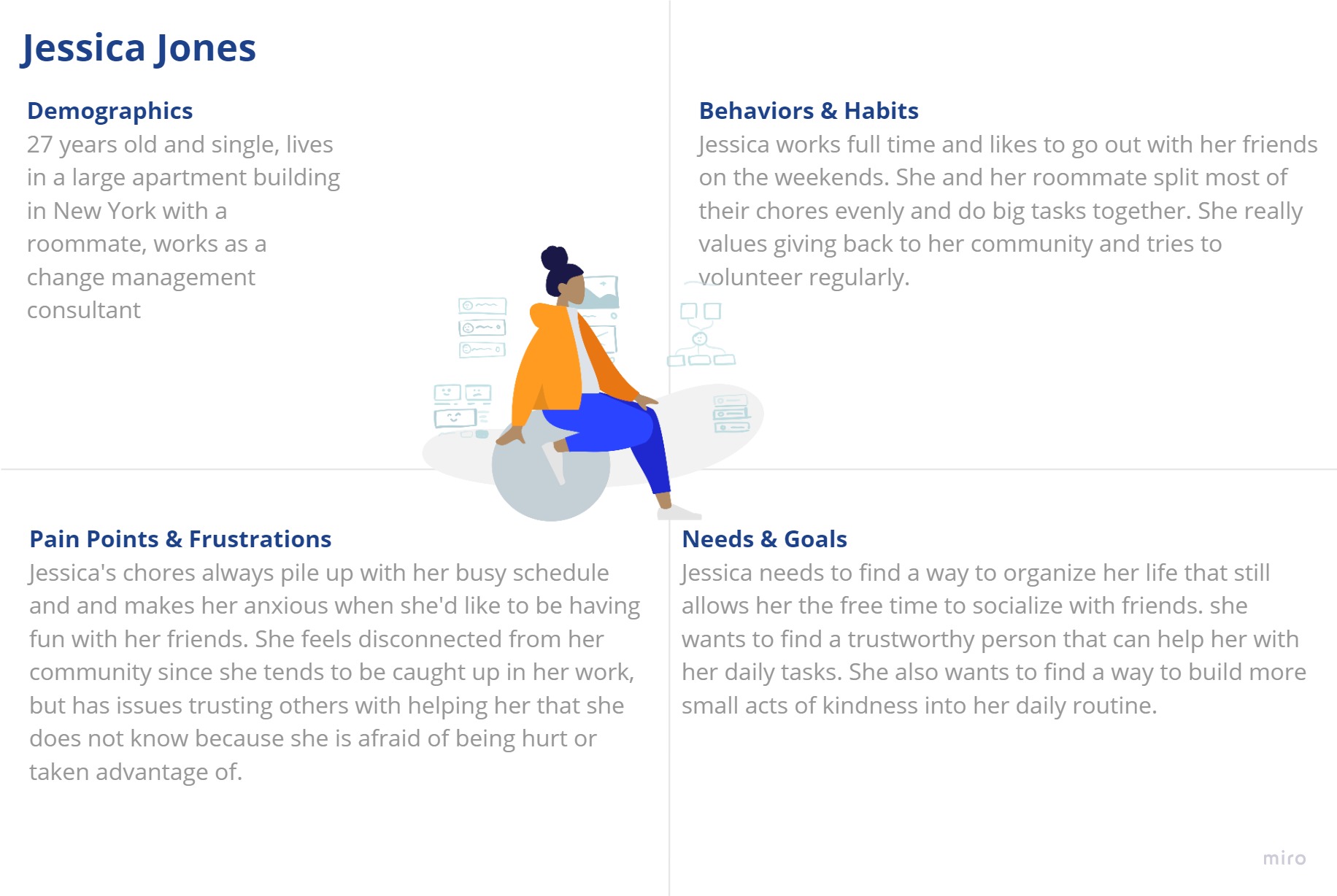
We created Jessica to embody our users - people with a desire to engage with their community but that may also require some assistance with their daily lives as well.
Using this persona, we narrowed down our initial question into our final problem statement: How might we encourage people to trust their neighbors and create a sense of community based on mutual aid?
Ideation
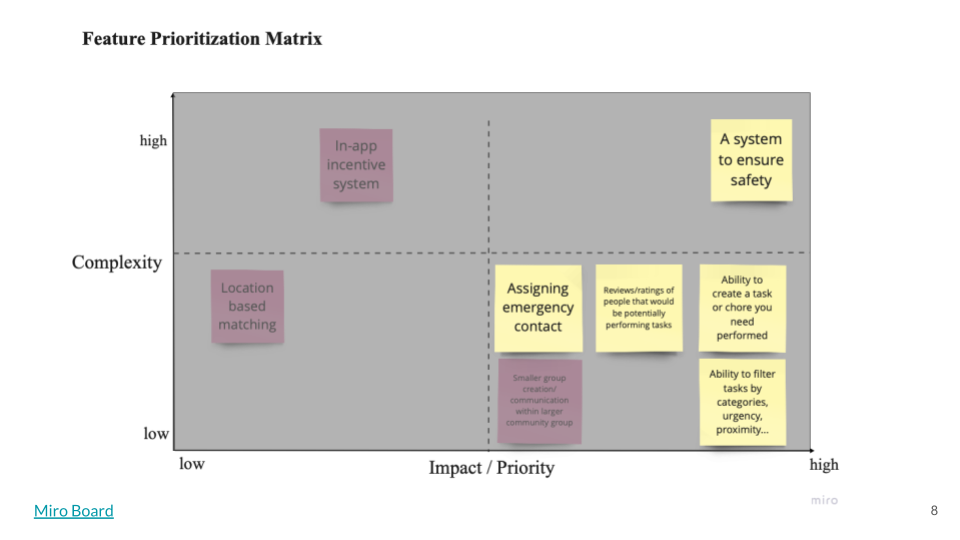
While our intial ideas for this app spanned a wide range of features, we need to scale down to a scope that was feasible for our 3 week timeline. We focused on features that would drive a sense of trust among users since our research showed this was the biggest hurdle to asking for help.
Our project scope is highlighted on the yellow sticky notes.
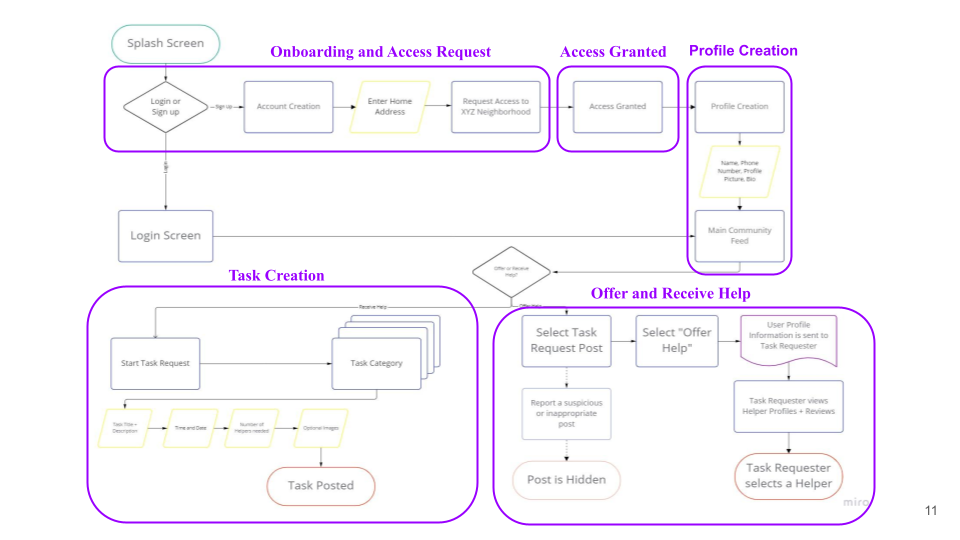
The final flow we decided on was:
Prototype Iterations
We started by conducting 5 user tests on an initial paper prototype and found some clarity issues with unabled icons and input fields and buttons looking too similar. We also discovered that we needed to iterate the flow to make the verification process for new sign ups more apparent to drive trust in the community.
New User Flow:
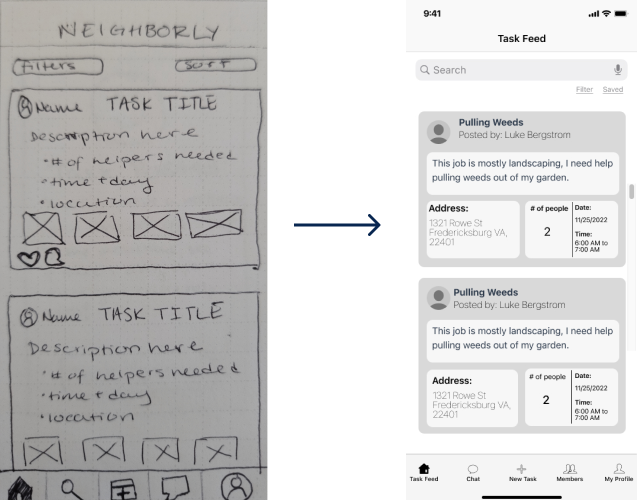
Adding labels to the navigation icons
Justification: There were discrepencies between how different users interpreted each icon, so we added labels for clarity.
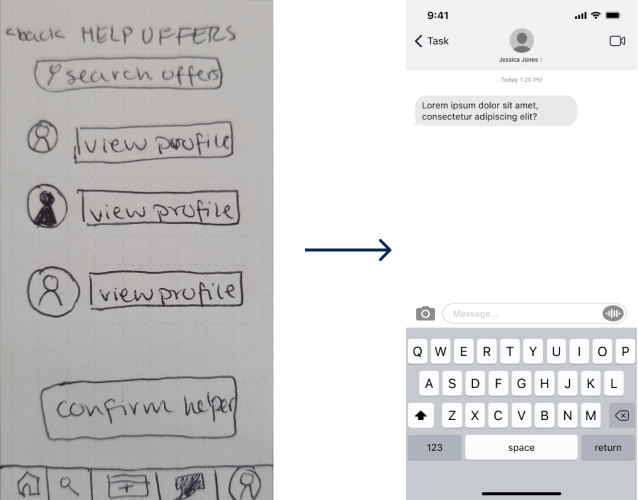
Implementing in-app chat functionality
Justification: Users need a way to communicate with their helper and this allowed for contact information to remain confidential for increased security.
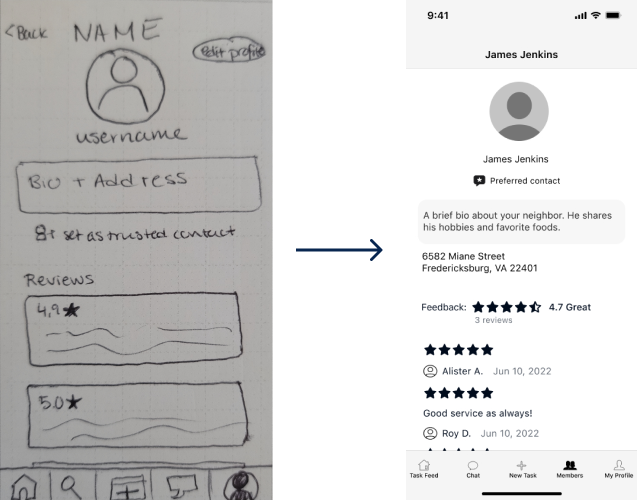
Addiing the option to set preferred contacts.
Justification: With trustworthiness and safety at the core of this experience, we needed to give a way for users to be able to quickly contact a trusted neighbor in case of emergencies.
Final Solution
After making all the iterations from our testing, this is our final mid-fidelity deliverable.
Concluding Thoughts
This was my first exercise in developing a solution from scratch, and I’m really proud of our final iteration. However, there’s a lot more work needed to complete this app that fell outside of our initial scope:
Future iterations would include designing the rest of the site and continuing to iterate on the design system.
- We would like to create an in-app incentive system for task completion. Rather than monetary rewards, we imagine a point system that build up to different rewards within the app.
- Now that this idea has been properly validated from user feedback, it's also time to create and implement and brand and style guide for a high fidelity mockup.